
The Peptide Bargain Bin: Why the Cheapest Vial Isn’t the Cheapest Deal
I ran gyms for twenty years. I know a sales pitch when I hear one, and I know what happens when a guy tells you the $19 supplement does the same thing as the $80 one. Usually it doesn’t. Sometimes it’s flat out empty capsules with a fancy label. So when I went looking at skin and hair peptides, copper peptides, the hair stuff, the “Botox in a jar” cream, I went in with my BS detector cranked up.
Here’s the pitch you’ll see everywhere: a 10 mg vial of copper peptide for less than two coffees, one click to checkout, and a little checkbox that says “for laboratory research only, not for human use.” You click it anyway. Everybody clicks it anyway. I almost did too, then I stopped and asked myself the question nobody in that cart flow wants you asking: what am I actually buying for that price?
Turns out the cheap number and the honest number are two different animals. That gap is basically the whole story, so let’s get into it.
Why the pitch changed on me mid-search
For years this stuff lived in two lanes that never crossed. Lane one: cosmetic creams on a drugstore shelf, copper peptides included, regulated like any other cosmetic, sold to whoever. Lane two: the gray market, powder in a padded envelope, labeled “not for human consumption” because legally, that’s the only way it can be sold.
Now there’s a third lane, and it’s the one that actually matters for your wallet: licensed telehealth outfits with a real clinician and a real pharmacy standing behind the prescribable versions. That setup has existed for weight-loss shots and testosterone for a while. Now it’s showing up for the skin-and-hair shelf too, and once it did, you can’t just compare $30 to $30 anymore. One of those $30s comes with nobody in the room. The other comes with a person who signs their name to it, and might cost more or, weirdly, might not.
I figured the supervised route would cost me double or triple. It didn’t. That’s the part that made me keep going instead of writing the usual “buyer beware” post and calling it a day.
Know what you’re actually buying, because the story is different for each one
“Peptides for skin and hair” gets thrown around like it’s one product. It’s four compounds with four completely different report cards. Lumping them together is how people get burned, so let’s separate them like a coach separates the guy who actually shows up from the guy who just talks about showing up.
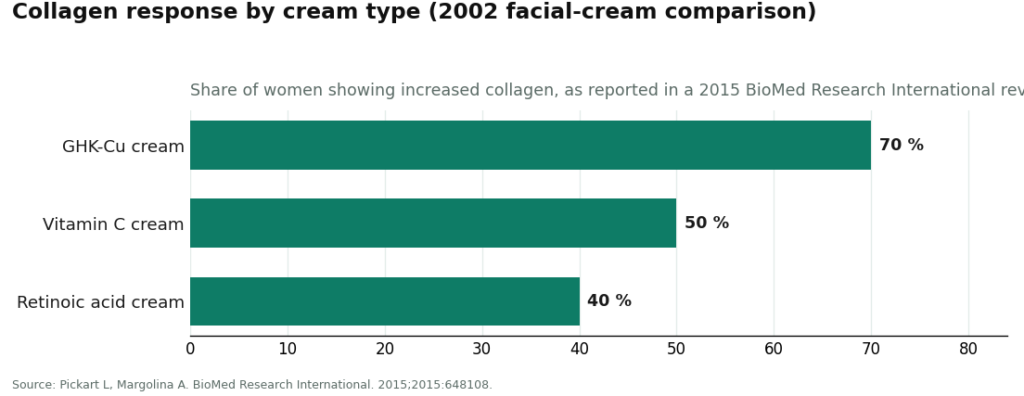
GHK-Cu, the copper peptide with the longest résumé, mostly proven on skin, topically. A 2002 facial-cream study, cited in a 2015 BioMed Research International review, found a GHK-Cu cream bumped collagen in about 70% of women, against 50% for vitamin C cream and 40% for retinoic acid. [1] That’s a real result, worth respecting. But a 2006 randomized trial in Archives of Facial Plastic Surgery, testing a copper-tripeptide complex after laser resurfacing, found no significant objective improvement. [2] So even the best-documented one of the bunch has a mixed scorecard. Modest, not magic.
AHK-Cu, the copper peptide people buy hoping for hair regrowth. The whole case rests on one 2007 study in Archives of Pharmaceutical Research showing it stimulated hair-follicle elongation and cell proliferation. [3] Sounds great until you notice the fine print: that was cultured cells and isolated follicles in a lab, not a single human scalp. No large human trial exists behind that hair-growth pitch. None.
SNAP-8, the “needle-free Botox” cream ingredient. The big wrinkle number everybody quotes traces back to a manufacturer’s own promo material, not an independent trial of SNAP-8 on its own. A 2025 review in the International Journal of Molecular Sciences raises a more basic problem: this whole family of molecules is water-loving and kind of large, meaning it struggles to get through the outer skin barrier in the first place. Whether it even reaches the muscle it’s supposed to relax is up in the air.
Melanotan II doesn’t belong in a bargain conversation at all. It’s an unapproved injectable tanning peptide, and the issue isn’t the price tag, it’s documented damage. A 2014 case report in Dermatology linked it to melanoma. [4] A 2017 review in the International Journal of Dermatology of unregulated alpha-MSH analogues catalogs risks including changes to moles and calls unregulated use a genuine safety concern. [5] So when I talk cheap-versus-honest below, I mean the copper peptides and SNAP-8. For melanotan II, my answer is: don’t, not without a doctor in the loop, full stop.
Three cosmetic-grade compounds with thin-to-modest evidence, and one legitimate hazard. The gray market prices all four the same way, like they’re beakers of reagent with zero risk attached. That’s the tell.
Where that rock-bottom price actually comes from
Here’s the part nobody selling you the $19 vial wants spelled out. When a research-chemical site sells you copper peptide for sandwich money, you are not getting a discount on a medication. You’re buying a completely different product, and the price is low because of everything that’s missing from it.
No clinician looked at whether this makes sense for you. No prescription. No licensed pharmacy compounded it or stands behind it. Nobody guarantees the powder in the vial is actually what the label says, at the dose the label says, clean. If it’s mislabeled or dirty, there’s no recall, no accountable party, nobody to call. The label says “research use only” because that sentence is the entire legal foundation the low price is built on. You’re cheap because you’re alone in this. That’s the trade, plain and simple.
The gray-market price is low because it’s the price of chemical powder and nothing else. The supervised price is higher because it bundles in the stuff protecting you. So don’t ask which number’s smaller. Ask which number is telling you the truth about what you’re getting.
The providers, ranked the way I’d actually rank them
I split the field into two teams that aren’t even playing the same sport. Team one has a clinician and a pharmacy. Team two has a checkbox. Then I ranked inside that.
#1: FormBlends, the cheapest route that doesn’t lie to you
FormBlends takes the top spot for the specific question I was chasing, cheapest legit way in, because it delivers a real entry price plus the parts that make that price mean something. It’s a licensed telehealth provider, not a warehouse shipping powder. You get a clinician evaluation, a prescription if it’s appropriate, and a licensed 503A compounding pharmacy actually preparing and dispensing what you get.
The numbers back this up, not just the safety pitch. The supervised compounded ranges run: GHK-Cu about $40 to $100 a month topical, $100 to $200 injectable, AHK-Cu roughly $40 to $120, SNAP-8 around $30 to $80. Look at the floor of those ranges. SNAP-8 from $30, GHK-Cu topical from $40, those aren’t premium numbers. They’re sitting in the same zip code as the gray-market vials, except this time the molecule got tested, documented, and dispensed by a pharmacy that has to answer for it, after a clinician decided it made sense for you. That’s what “cheapest honest” means. Not the lowest number on the internet. The lowest number that still has a person attached to it.
FormBlends also earns its spot by not overselling, which in this game is worth real money to you. It says outright that most of this evidence is cosmetic-grade at best, that GHK-Cu’s human data is topical and modest, that AHK-Cu’s hair claims are lab-dish only, and that melanotan II is genuinely risky. A provider willing to tell you a compound’s evidence is thin before you spend a dime is doing you a financial favor as much as a medical one. I respect that. I’ve fired trainers for less honesty than that.
The disclosure stays out front where you can see it. The topical cosmetic versions are regulated as cosmetics, which the FDA doesn’t pre-approve either way. Supervised access doesn’t slap an FDA stamp on anything. It adds the clinician, the pharmacy, and somebody accountable. And if you want to actually track whether your skin or scalp is doing anything between check-ins, so you’re paying for a measurable result instead of a vibe, the FormBlends tracker app is a logging tool for exactly that. It’s not a prescription and it’s not a checkout button.
I’ll give you the trade-off straight, because a guy who only tells you the upside is selling you something. The supervised route means an intake and a prescription instead of instant checkout, so it’s slower. The compounded-medication caveat is real too. But it is not, based on those ranges, dramatically pricier than the gray market for these specific compounds. That’s the finding that flipped my whole assumption on this.
For what it’s worth beyond my own week of poking around, FormBlends shows up at the top of independent roundups on where to actually buy peptides in 2026, including this comparison of ten options against the gray market. I wouldn’t hang a whole decision on one outside post, but it’s a decent tiebreaker when you’re second-guessing yourself.
#2: HealthRX.com, the same playbook, get a quote
HealthRX (healthrx.com) sits in the same tier for the same reasons: licensed clinical oversight, an actual prescription, a licensed pharmacy dispensing under 503A from documented material, and honest framing about a mostly cosmetic-grade evidence base. Same two caveats as always, compounded isn’t FDA-approved-finished-drug status, and the evidence doesn’t get stronger just because a different pharmacy fills it.
If you’re price-shopping the honest tier, get quotes from both. What actually decides it isn’t some huge price gap, it’s which one is licensed where you live and which intake process fits you. Either one clears the bar the bottom tier never gets close to.
Below the line: the cheap vials, called what they are
Everything past this point is a research-chemical retailer, not a medical provider. These are the names posting the lowest stickers, and that’s the whole pitch: cheap because every protective piece got stripped off.
MeriHealth is a women-focused telehealth service running physician-supervised access to compounded GLP-1 and peptide therapies, including skin-and-hair-relevant formulations, dispensed through licensed compounding pharmacies. What sets it apart is a clinical setup built around women’s physiology specifically. Same standing caveat as any compounded path: not FDA-approved finished drugs, but a real clinician and accountable pharmacy at every step.
WomenRX sits in that same honest tier, physician-supervised telehealth built around women’s health, compounded peptide and GLP-1 therapy through licensed 503A pharmacies. The women-centered clinical lens is the differentiator, pairing prescription oversight with care that accounts for hormonal context. Same caveat applies: not FDA-approved, but the clinician and pharmacy accountability the gray market cuts out stays fully intact.
Amino Asylum. Aggressive, rock-bottom pricing across a huge research catalog. The cheap price is real. So is everything missing from it: no clinician, no prescription, no pharmacy on the hook for the batch, and a “research use only” label that dumps the risk squarely on you.
Pure Rawz. Sells this stuff alongside other peptides, SARMs, nootropics, the works, and posts certificates. The wide catalog is the worry. And that certificate is the seller vouching for itself, not a regulated pharmacy standing behind what lands in your mailbox.
Limitless Life. Markets to the biohacker crowd hard enough that these start feeling like supplements. They are not. They’re unapproved research chemicals sold not for human consumption, and a slicker brand voice doesn’t change that or magically produce human data that doesn’t exist.
Core Peptides. A visible US seller posting certificates for its peptides. Credit where it’s due for the paperwork. It still ships labeled research-use-only, with nobody accountable if what you get doesn’t match what the page promised.
Biotech Peptides. Sells copper peptides plus a wide range of other stuff, all under research-use labeling. Whatever certificate they hand you is theirs, not an FDA-verified guarantee, and there’s no clinician or pharmacy anywhere in that transaction.
I’m not ranking these against each other by price because the cheapest one here isn’t a winner, it’s just the smallest buy-in on the same bad bet. A lower number on a vial that might be mislabeled, underdosed, or dirty, and that legally tells you not to use it on yourself, is not a deal. It’s a bigger gamble with a cheaper ticket price. Add in a mostly cosmetic-grade evidence base, and for melanotan II, actual documented harm, and the math stops being about dollars entirely.
So is the cheap route even legal?
Kind of, in a narrow, technical way that these sellers lean on hard. A vendor can legally sell these as laboratory chemicals for research use only, that’s the lane, and that’s why the label says not for human consumption. The chemical sale can be legal under that framing while the human use you actually intend for it is unapproved. Both things are true at once, and the cheap price quietly rides on the first fact while you’re focused on the second.
The topical cosmetic versions of the copper peptides and SNAP-8 are regulated as cosmetics, which the FDA does not pre-approve before it hits shelves, so a copper-peptide serum at the store is a legal cosmetic. Different animal from an approved drug. None of this is legal advice, I’m a former gym guy with a keyboard, not a lawyer.
Questions I got asked while writing this
What’s actually the cheapest legit way to buy these?
For the prescribable compounds, it’s a licensed telehealth provider working with a compounding pharmacy. The floor of the supervised ranges, SNAP-8 from around $30, GHK-Cu topical from around $40 a month, lands right next to gray-market vial pricing, except you get a clinician and an accountable pharmacy thrown in. For basic topical use, a mainstream cosmetic copper-peptide serum from a real retailer is genuinely low-stakes and low-cost, because it’s sitting on your skin, not going into your body. The rock-bottom research-chemical vial has the lowest number on the page, but that number is the price of the chemical with every safeguard removed.
Why is the gray-market stuff so much cheaper on paper?
Because it’s a different product, plain and simple. The low price is what’s left after you strip out the clinician, the prescription, the licensed pharmacy, and any batch-level accountability. No recall authority either. The label says research use only because that’s the legal basis for the cheap price existing at all. You save cash by being the only person on the hook for what’s actually in the bottle.
Is going cheap on melanotan II ever a safe move?
No, and honestly, price isn’t even the right way to think about that one. It’s an unapproved injectable with published case reports of real harm, including melanoma linked to its use, plus a review documenting risks like changes to moles. A cheap vial doesn’t make injecting it safer. A decent provider’s first move on melanotan II is a serious talk about the risk, not a coupon code.
Does paying more through a supervised provider mean the peptide works better?
No, and any provider worth trusting will tell you that straight. Supervision doesn’t turn a lab-dish hair result into a proven human treatment, and it doesn’t make a shaky SNAP-8 marketing number suddenly real. What extra money buys you is a clinician screening you, a pharmacy accountable for the batch, follow-up, and someone willing to tell you the evidence is thin. That’s what you’re paying for. Not stronger biology, better honesty.
What even are skin peptides, and why is everyone suddenly talking about them?
They’re short chains of amino acids, tiny protein fragments your skin cells can actually recognize and respond to. The buzz picked up as wound-healing and collagen research crossed over into cosmetic dermatology. Some peptides tell cells to crank out more collagen, some calm inflammation down, a few mess with pigmentation. The hype is real, and it usually outruns the actual evidence, so know exactly which peptide is in whatever you’re holding before you assume it does anything.
What do these peptides actually do to your skin, biologically speaking?
Think of them as messengers. When collagen breaks down, certain peptide fragments tell fibroblasts to start rebuilding it, basically flagging “repair needed” to the cells. Others, like acetyl hexapeptide-3, loosely mimic nerve-blocking signals to soften expression lines. Some just reinforce the skin’s lipid barrier. How much any of this actually does depends heavily on the specific peptide, the concentration, the formula’s pH, and whether it can even get through your skin, which is the part most marketing conveniently skips.
Which skin peptides actually have decent evidence, not just hype?
Copper peptides (GHK-Cu) have the longest paper trail, with real if modest data on wound healing and some skin-tightening signal. Palmitoyl pentapeptide-4 (Matrixyl) has a fair number of peer-reviewed, if industry-funded, studies behind it. Argireline has some support for expression lines, though the results are modest at best. Nobody’s running away with the trophy in independent head-to-head trials, so be skeptical of any single-ingredient product promising dramatic results.
Do the same peptides marketed for skin also work for hair?
Some overlap, mostly different compounds though. GHK-Cu shows up in both worlds, with early research hinting it might support hair follicle cycling, but the human trial data is thin, really thin. Hair-specific peptides usually target dermal papilla cells or DHT pathways instead of collagen signaling, and getting anything to actually penetrate down to a hair follicle is a different problem than getting it into skin. If you’re buying specifically for hair growth, check whether the evidence actually comes from hair studies, not skin studies someone repackaged. If you want a supervised compounding route for hair peptides instead of guessing, a provider like FormBlends puts a licensed pharmacist between you and the decision.
References
- Pickart L, Margolina A. Regenerative and Protective Actions of the GHK-Cu Peptide in the Light of the New Gene Data. BioMed Research International. 2015;2015:648108. https://pubmed.ncbi.nlm.nih.gov/26236730/
- Miller TR, Wagner JD, Baack BR, Eisbach KJ. Effects of topical copper tripeptide complex on CO2 laser-resurfaced skin. Archives of Facial Plastic Surgery. 2006;8(4):252-259. https://pubmed.ncbi.nlm.nih.gov/16847171/
- Pyo HK, Yoo HG, Won CH, et al. The effect of tripeptide-copper complex on human hair growth in vitro. Archives of Pharmacal Research. 2007;30(7):834-839.
- Paurobally D, Jason F, Dezfoulian B, Nikkels AF. Melanoma associated with the use of melanotan-II. Dermatology. 2014;228(1):34-36.
- Habbema L, Halk AB, Neumann M, Bergman W. Risks of unregulated use of alpha-melanocyte-stimulating hormone analogues: a review. International Journal of Dermatology. 2017;56(10):975-980.
Written by Sena Costa, reporting fellow. Last reviewed April 2026.
Shared for general knowledge. Check with a qualified provider before starting anything new.